
When you have POTS, there can be a lot to keep track of.
You might feel dizzy one afternoon, have heart palpitations the next morning, and feel completely exhausted after doing something that normally wouldn’t bother you. When symptoms change from day to day, it can be hard to remember what happened—let alone figure out whether there’s a pattern.
That’s where symptom tracking can help.
A POTS symptom checklist isn’t just about making a list of symptoms you have. It can help you keep track of what happened, when it happened, and what else was going on at the time.
Here’s what I find useful to track.
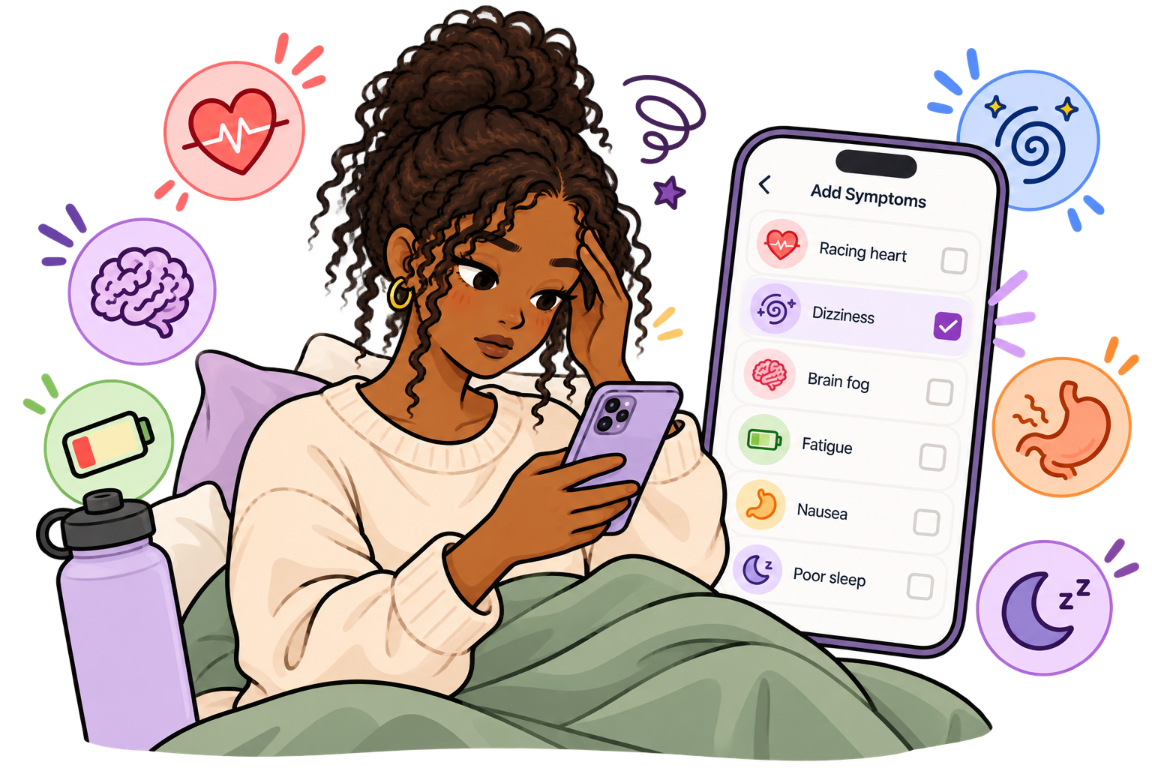
1. Start with the POTS symptoms that matter to you
There are a lot of symptoms associated with POTS. You don’t necessarily need to track all of them.
Some symptoms you may want to track include:
- Racing heart or heart palpitations
- Dizziness or lightheadedness
- Brain fog
- Nausea
- Fatigue
- Heat intolerance
This isn’t meant to be a complete explanation of POTS symptoms. If you’re trying to understand what POTS symptoms can feel like, why they happen, and when they tend to get worse, read our complete guide to POTS symptoms.
For tracking, I’d focus on the symptoms that actually affect you.
If dizziness is one of your biggest problems, track dizziness. If nausea has suddenly been getting worse, start there.
2. Don’t just track the symptom
Writing down “dizzy” tells you that you experienced dizziness.
Adding a little context can make that information much more useful.
For example:
Symptom: Dizziness
Time: 2:15 PM
What I was doing: Standing in line
How bad was it? Bad enough that I needed to sit down
Other symptoms: Racing heart and shaky hands
What helped: Sitting down
Now you know much more than simply “I was dizzy on Tuesday.”
When a symptom happens, some things you may want to pay attention to include:
- When it happened
- What you were doing
- Whether you were sitting, standing, or lying down
- How severe it was
- How long it lasted
- Whether other symptoms happened at the same time
- What seems to make them better
You don’t necessarily need to record all of these things every time. Even just a few pieces of information can help you and your doctor find your symptom patterns.
3. Track the things that might affect your symptoms
Sometimes the useful information isn’t the symptom itself. It’s what was happening around it.
Depending on what you’re trying to understand, you may want to keep track of:
- Hydration: How much water or other fluids did you drink?
- Sodium: How much sodium did you get that day?
- Medications: What did you take and when?
- Exercise: Did you exercise? What kind and for how long?
- Meals: Did symptoms happen before or after eating?
- Sleep: Did you sleep particularly well or poorly?
- Heat: Were you outside in hot weather or taking a hot shower?
- Illness: Were you sick or recovering from being sick?
- Menstruation: Do your symptoms change around your period?
- Heart rate and blood pressure: If you’re already measuring them, what were they around the time you experienced symptoms?
The important word here is might.
If you’re trying to understand whether your dizziness is related to hydration, tracking your water intake could be useful. If you’re trying to understand whether your symptoms are worse after meals, meal timing might matter more.
4. You don’t need to track everything
This is something I’ve learned from managing my own POTS.
There are seemingly endless things you could keep track of. But trying to record everything can quickly become another chore.
I find it more useful to start with a question.
For example:
“Why have I been so dizzy in the afternoon?”
Then I can think about what information might help me answer that question.
When I tracked my dizziness alongside my hydration, I realized I tended to feel worse if I hadn’t had at least 32 ounces of water by 1 PM and another 32 ounces by 6 PM.
That doesn’t automatically prove that dehydration caused the dizziness. But it gives me a pattern I can pay attention to.
Or maybe I don’t find a pattern at all.
That’s useful information too.
5. Track good days too
It’s very easy to only think about tracking when you’re having a bad POTS day.
But good days can give you useful context.
Maybe you notice that you were less dizzy on a particular day. What was different?
- Did you drink more water?
- Did you get more sleep?
- Was it cooler outside?
- Did you eat differently?
- Did you exercise?
- Did you take your medications at different times?
One good day doesn’t prove that any of those things made you feel better. But looking at both good and bad days over time can help you understand your own patterns.
6. How I track my POTS symptoms
One of the reasons I built POTSie was because I was tired of keeping all of this information in my head.
If I felt dizzy, I wanted to record that quickly and move on with my day.
But later, I also wanted to be able to look back and see what else had been happening.
- How much water was I drinking?
- Was I getting enough sodium?
- Had I exercised?
- Did I take my medication?
- Was I experiencing other symptoms at the same time?
Trying to remember all of that weeks later is difficult.
So instead of treating symptoms as isolated events, I prefer to look at them alongside the other parts of managing my POTS.
7. Tracking symptoms with POTSie
POTSie’s symptom tracker is designed to make recording a symptom quick.
If you’re feeling dizzy, for example, you can open POTSie, record dizziness, and get back to what you were doing.
You can also use POTSie to keep track of things like:
- Heart Rate
- Water
- Sodium
- Medications
- Blood pressure
- Exercise
- Daily notes
Having that information together makes it easier to look back at what was happening on a particular day instead of trying to reconstruct it from memory.
You don’t need to log every possible data point. Track the information that’s useful to you.
Download POTSie on the Apple App Store or Google Play Store to start tracking your symptoms and routines.
8. Look back for patterns
Tracking isn’t particularly useful if you never look at what you’ve recorded.
Every so often, take a look back and ask:
Are certain symptoms happening repeatedly?
Maybe nausea keeps showing up in the evening.
Do symptoms tend to happen together?
Maybe dizziness, a racing heart, and shakiness often occur at the same time.
Are there particular situations where you tend to feel worse?
Maybe your worst days tend to follow poor sleep, happen in hot weather, or occur after a lot of standing.
Is something changing?
Maybe a symptom that used to happen once a week is now happening almost every day.
You don’t have to find an explanation for everything. The goal is simply to make patterns easier to notice.
9. Use your symptom history when talking with your doctor
One of the hardest questions for me to answer at a doctor’s appointment is some version of:
“How have you been feeling?”
Suddenly, I’m trying to summarize weeks or months of good days, bad days, symptoms, medications, and everything else from memory.
Having a symptom history gives you something more concrete to work from.
You may be able to tell your doctor:
- Which symptoms are affecting you most
- When those symptoms tend to happen
- How frequently they’re happening
- Whether they’re becoming better or worse
- What seems to trigger them
- What seems to help
- Whether certain symptoms happen together
- Any heart rate or blood pressure information you’ve already collected
You don’t need perfect data. Even a few specific examples can make it easier to explain what you’ve been experiencing.
A POTS symptom checklist isn’t a diagnosis
Tracking your symptoms can help you understand and communicate what you’re experiencing. It can’t tell you whether you have POTS.
Many POTS symptoms overlap with other conditions, and POTS has specific diagnostic criteria that go beyond a list of symptoms.
If you’re trying to figure out whether the symptoms you’re experiencing could be related to POTS, read What Are the Symptoms of POTS? It goes into more detail about common symptoms, what they can feel like, when they tend to get worse, and how symptoms relate to a POTS diagnosis.
If you’re experiencing new, severe, or concerning symptoms, talk with a healthcare professional.