
POTS, or Postural Orthostatic Tachycardia Syndrome, is a disorder of the autonomic nervous system that affects how your body responds to being upright. One of its defining features is an excessive increase in heart rate after standing, but POTS can affect much more than heart rate, including circulation, energy, digestion, thinking and exercise tolerance.

POTS is a form of dysautonomia, an umbrella term for disorders involving the autonomic nervous system, the part of your nervous system that automatically regulates things like heart rate, blood pressure, sweating and digestion.
When I was first diagnosed, what helped me understand my POTS was learning what was actually happening in my body: why being upright could cause symptoms, how my body was trying to compensate, and how things like hydration, sodium, exercise and medication could help address those problems. Understanding that POTS involves the autonomic nervous system gave me a much clearer framework for making sense of both my symptoms and the things I could do to manage them.
What does POTS stand for?
Each part of Postural Orthostatic Tachycardia Syndrome describes something about the condition:
- Postural refers to your body’s position.
- Orthostatic means related to standing upright.
- Tachycardia means an unusually fast heart rate.
- Syndrome refers to a recognizable pattern of signs and symptoms that tend to occur together.
Put simply: when someone with POTS is upright, whether they’ve just stood up, have been standing for a while, or are walking around, their body can have difficulty maintaining normal circulation. Their heart rate may rise more than expected, and symptoms can develop or worsen the longer they remain upright.
What happens when you have POTS?
Every time you stand, gravity pulls some of your blood toward your legs and abdomen.
Normally, your body compensates automatically. Your autonomic nervous system tightens blood vessels and makes other small adjustments that help return enough blood to your heart and brain.
With POTS, that response doesn’t work normally.
There isn’t one single reason why. In some people, blood vessels may not constrict effectively. Some have lower-than-expected blood volume. Others have an unusually strong sympathetic, or “fight-or-flight,” response. More than one of these things can happen at the same time.
The result can be less blood returning to the heart while you're upright. Your body may try to compensate by increasing your heart rate and activating other parts of the autonomic nervous system.
This was one of the biggest things that helped POTS make sense to me. At first, I thought the racing heart was the problem itself. But the increased heart rate can actually be part of the body's attempt to compensate for something else going wrong with circulation while you're upright.
That doesn’t make the fast heart rate unimportant. It just explains why treating POTS is often more complicated than simply trying to slow the heart down.
A racing heart in POTS is often the body’s response to a circulation problem while upright. That’s why management often looks at what’s happening underneath, not just the heart rate itself.
What are the symptoms of POTS?
POTS can cause symptoms throughout the body.
Common symptoms include a racing or pounding heart, dizziness or lightheadedness, fatigue, brain fog, difficulty exercising and nausea. Symptoms often become worse while upright, although POTS can also cause symptoms that aren’t directly tied to standing.
Not everyone with POTS has the same symptoms, and you do not need to faint to have POTS.
That variability can be confusing, especially when you're first trying to figure out whether all the things you're experiencing could really be connected to the same condition.
I've written a separate guide covering POTS symptoms, including what they can feel like, when they tend to become worse and how symptoms can differ from person to person.
What are the different types of POTS?
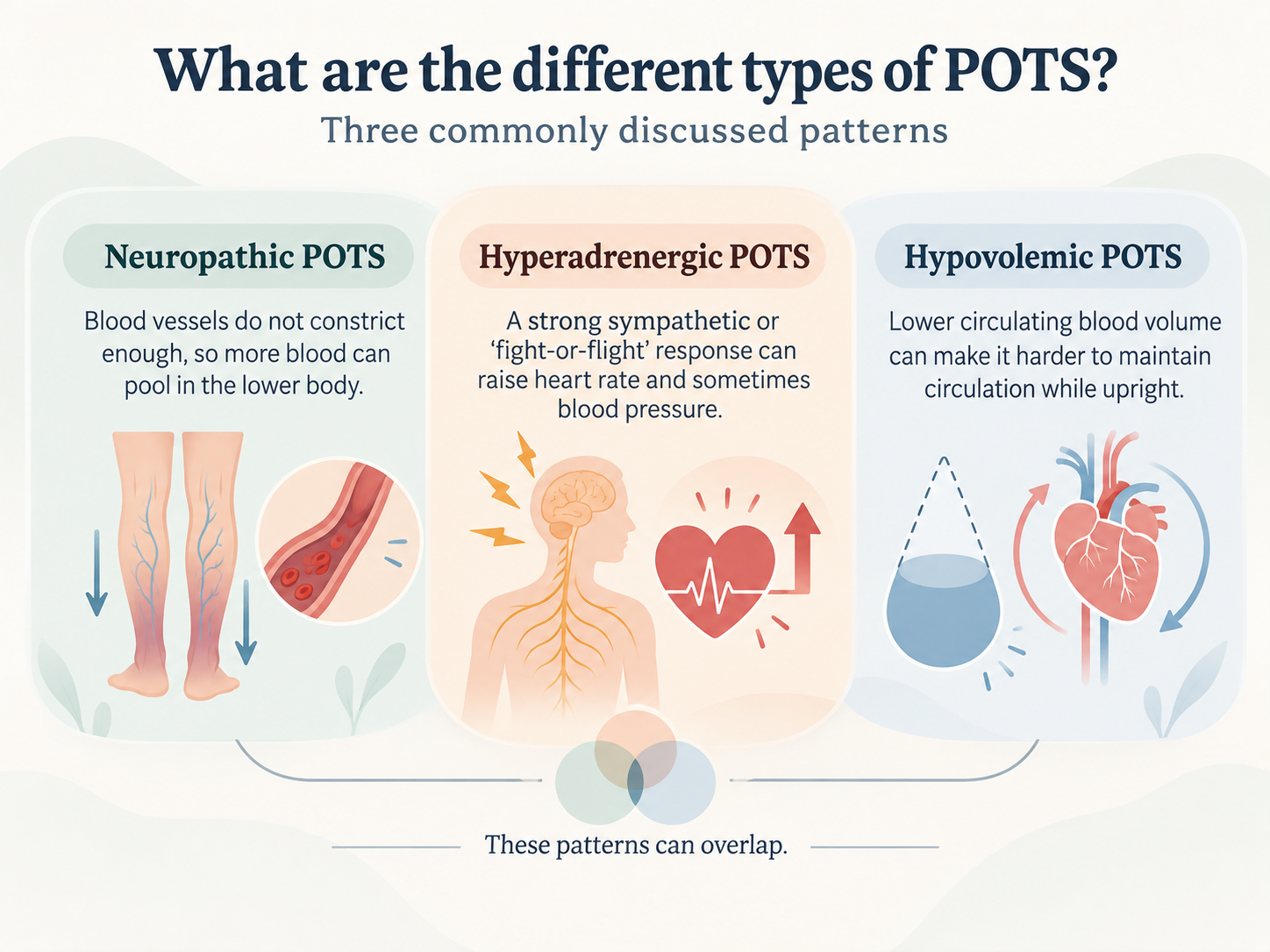
POTS can involve several overlapping physiological patterns, which helps explain why the condition looks different from person to person and why the same treatment may not work equally well for everyone. I was never given a specific subtype, but learning about these mechanisms helped me better understand why POTS can be managed in different ways.
Three of the most commonly discussed POTS patterns are:
- Neuropathic POTS
- Hyperadrenergic POTS
- Hypovolemic POTS
People often refer to these as different “types” of POTS, but they aren’t always separate categories. A person can have features of more than one at the same time.
Neuropathic POTS
In neuropathic POTS, the nerves that help control the blood vessels, particularly in the lower body, may not work properly.
When you stand, your blood vessels are supposed to tighten to limit how much blood pools in your legs and abdomen.
In neuropathic POTS, that constriction may be impaired because the small autonomic nerve fibers controlling those blood vessels aren’t functioning normally. More blood can remain in the lower body, which means less blood returns to the heart.
The body may compensate by increasing the heart rate to keep enough blood circulating.
A simple way to think about it is:
Blood vessels don’t tighten enough → more blood pools below the heart → less blood returns to the heart → heart rate increases to compensate.
Hyperadrenergic POTS
In hyperadrenergic POTS, there is unusually strong activation of the sympathetic nervous system, the part of your nervous system involved in the body's “fight-or-flight” response.
One of the main chemical messengers involved is norepinephrine.
Norepinephrine normally helps your body maintain circulation when you stand by increasing heart activity and tightening blood vessels. In people with hyperadrenergic POTS, this response can become exaggerated.
Standing norepinephrine levels of 600 pg/mL or higher are often used as one marker of a hyperadrenergic pattern. Some people also experience an increase in blood pressure when they stand rather than a decrease.
In simple terms:
Standing triggers a strong sympathetic response → norepinephrine rises → heart rate and sometimes blood pressure increase.
This can help explain symptoms such as shaking, sweating or a particularly forceful heartbeat in some people.
A hyperadrenergic response also isn’t always the original problem. If the body is already struggling to return enough blood to the heart, releasing more norepinephrine may be part of its attempt to compensate.
Hypovolemic POTS
Hypovolemia means having a lower-than-normal volume of circulating blood.
Some people with POTS have reduced plasma or blood volume.
When you stand, some blood naturally moves downward because of gravity. If you already have less circulating blood than expected, there is even less available to return to the heart.
The heart may compensate by beating faster to help maintain circulation.
In simple terms:
There is less circulating blood → standing reduces the amount returning to the heart even further → heart rate increases to compensate.
Researchers are still studying why blood volume is reduced in some people with POTS. Problems with the systems that regulate fluids, sodium and blood volume may play a role.
This also helped me understand why things like hydration and sodium came up so often when I was first learning how to manage POTS. They can directly affect circulating blood volume, although the right amount varies by person and increasing sodium isn’t appropriate for everyone.
Hydration and sodium can affect circulating blood volume, but the right amount varies by person. Talk with your doctor before increasing your sodium intake.
Can you have more than one type of POTS?
Yes. These mechanisms can overlap.
For example, someone may have blood vessels that don’t constrict effectively, leading to blood pooling. Their body may then respond by releasing more norepinephrine, creating hyperadrenergic features. They could also have lower-than-normal blood volume at the same time.
That’s why POTS doesn’t always fit neatly into one subtype. These labels are most useful for describing what may be contributing to someone’s POTS, rather than assigning every person to one fixed category.
What causes POTS?
There isn’t one single known cause of POTS.
For some people, symptoms begin after an infection. Research has also looked at possible roles for autonomic neuropathy, immune dysfunction, blood-volume regulation, connective tissue abnormalities and other factors. For others, they may have had symptoms for many years but never known that it was POTS.
How is POTS diagnosed?
A POTS diagnosis involves more than simply noticing that your heart rate gets high.
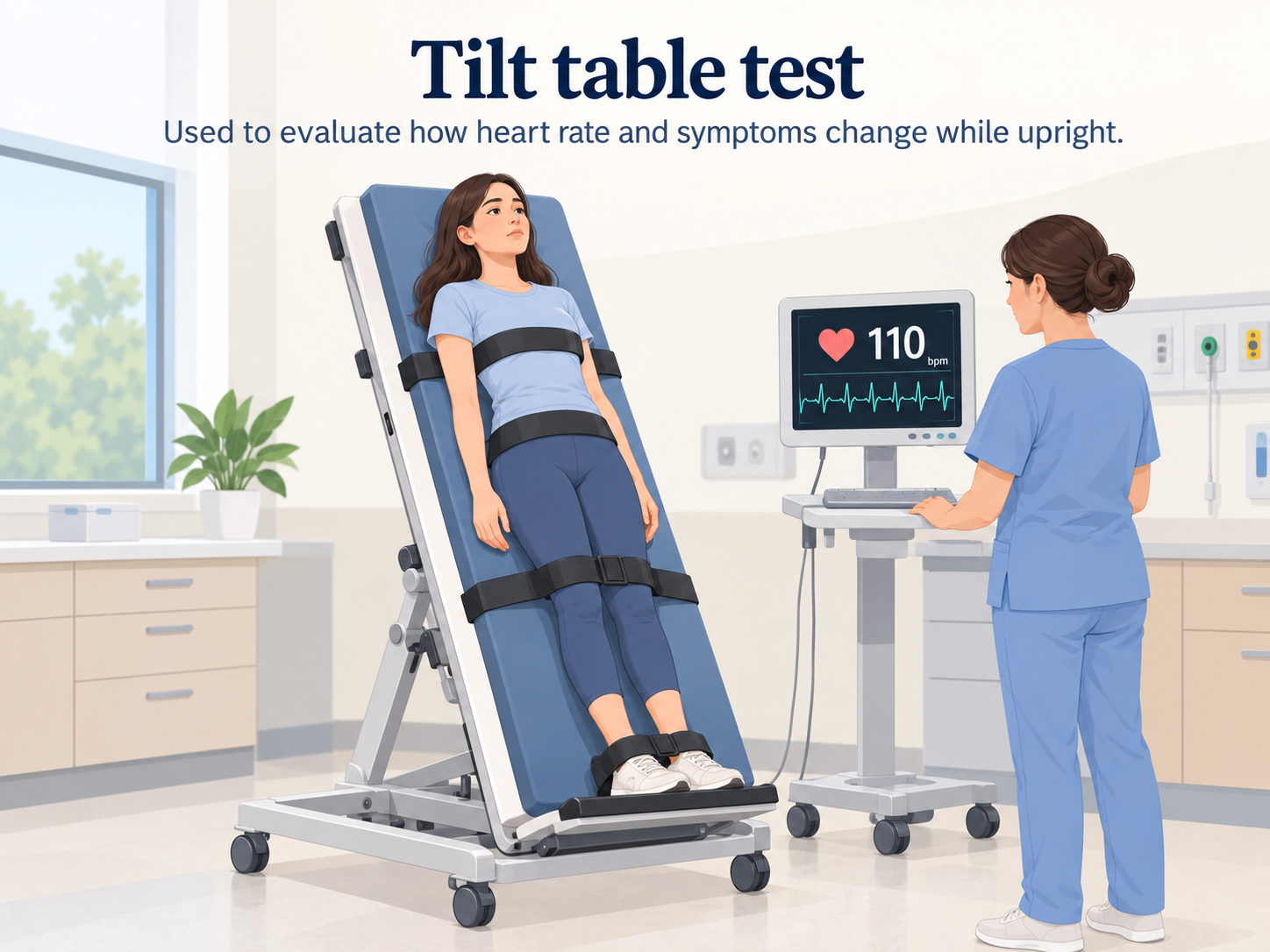
Current diagnostic criteria look for symptoms of orthostatic intolerance together with a sustained heart-rate increase of at least 30 beats per minute in adults or 40 beats per minute in adolescents ages 12–19 within 10 minutes of standing or head-up tilt, without the blood-pressure drop that defines orthostatic hypotension.
Doctors may evaluate this using a standing test or tilt-table test.
They also need to consider other things that can cause tachycardia or similar symptoms, such as dehydration, anemia, thyroid disease, medications and other medical conditions.
That distinction matters. Seeing your heart rate jump by 30 beats per minute on a smartwatch doesn’t automatically mean you have POTS.
When I was diagnosed, I was experiencing more than a high heart rate. Other random things were happening too, like getting nauseous when I got out of bed at night to use the bathroom, feeling my heart chronically beating in my chest, and a jitter that I couldn't get rid of no matter how much I tried to calm down. The heart-rate change was one of the easiest things to see and measure, but getting diagnosed meant putting that number together with my symptoms and the rest of the clinical picture.
If you think you might have POTS, write down your symptoms and any heart-rate readings you notice, including what you were doing at the time. They won’t diagnose POTS on their own, but they give your doctor useful context.
How is POTS treated or managed?
There isn’t one treatment plan that works for everyone with POTS.
Management often involves several strategies aimed at helping the body maintain circulation and tolerate being upright. Depending on the person, that may include:
- increasing fluids
- increasing sodium when medically appropriate
- compression garments
- gradually structured exercise
- learning and preparing for triggers
- medications targeted to specific symptoms or physiological problems
When I was first managing my own POTS, my doctor’s recommendations included medication, hydration, sodium and exercise.
What surprised me was how much the work happened outside the doctor’s office. Knowing the recommendations was one thing. Consistently doing them and figuring out which things actually made a noticeable difference was another.
That’s part of why POTS management can feel overwhelming at first. There often isn’t one medication or one change that fixes everything.
Treatment should be individualized, and what helps one person with POTS may not be appropriate for another.
If you're exploring management options, see the dedicated guides to increasing your salt intake, and the CHOP POTS exercise protocol that I followed to recondition my body.
Tracking POTS over time
One of the hardest parts of POTS for me was the variability. I could feel relatively good one day and much worse another, and it wasn’t always obvious why. Over time, I found it more useful to track only the information related to a specific question, such as whether symptoms change after certain activities, meals, treatments or other possible triggers.
You don't need to track everything. A pattern doesn't prove that one thing caused another, but keeping a focused history can make it easier to notice changes, remember what happened and have a more concrete conversation with your doctor.
Start with one question, like whether your symptoms change after certain activities or meals, and track only what helps you answer it.
That experience is ultimately why I built POTSie. I wanted one place to keep track of the pieces of POTS I was already trying to manage, including symptoms, heart rate, blood pressure, hydration, sodium, medications, exercise and notes, without having to reconstruct everything from memory later.
For a more practical approach to deciding what is worth tracking, see the POTS symptom checklist and tracking guide.
The bottom line
POTS, or Postural Orthostatic Tachycardia Syndrome, is a disorder of the autonomic nervous system that affects how your body responds to being upright.
The increased heart rate is one of its defining features, but it's only one part of what is happening.
Neuropathic, hyperadrenergic and hypovolemic POTS are three commonly discussed patterns, but they can overlap. You also don’t necessarily need to be assigned one specific subtype for understanding these mechanisms to be useful.
When I was first diagnosed, I wanted POTS to have a simple explanation for what was happening in my body and what I could do about it.
My experience has been much less tidy than that.
What became more useful was understanding what POTS was doing in my body, following the treatment plan my doctor gave me, and gradually learning the patterns that made my symptoms better or worse.
POTS can involve a lot of moving pieces. You don’t have to understand all of them at once.